


Leading Without a Scoreboard
March 21, 2026
Read Time - 4 minutes
"The deepest hunger in human nature is the craving to be appreciated." ~ William James
There's an old joke about leaders: people celebrate you when you arrive and celebrate again when you leave. What’s unsaid is the middle part — the years you actually spend doing the work — is mostly quiet.
A few years ago, I spent months working on a major curricular initiative. Faculty meetings, subcommittees, revisions, political navigation, more revisions. When it finally passed, I was energized — it was a major leap forward for our program. The curriculum committee chair and I congratulated each other — the academic equivalent of a fist bump — and then I moved on to the next thing (because that's what you do). Not a word from anyone else. There just wasn't anyone around to say nice work, this matters.
Crickets.
And it was oddly deflating.
In those moments, I've learned to tell myself that people are busy. My priorities aren't always their priorities. And the absence of applause doesn't mean the absence of impact. I even wrote about this in a past newsletter issue — the maddening reality that leadership feedback, when it does arrive, often contradicts itself. One person reads your decision as bold leadership. Another reads the same decision as tone-deaf administration. You can't win that game, and you shouldn't try.
But I'd be dishonest if I said the silence was always easy.
There's a good chance you've felt this too.
Think about the relationship with your bosses for a moment. When did any of us last tell them they were doing a great job? Complimenting your boss carries its own risks — it can feel like flattery, like positioning. So we hold back. And the pattern repeats all the way up the org chart. Your boss isn't getting much encouragement either — and neither is theirs. The result is a system that relies almost entirely on our inner compass. We've collectively decided — without ever quite deciding it — that leaders should simply know they're doing well. That's a heavy thing to ask of anyone.
So here's the question: if I can't rely on what's coming from the outside, what do I rely on instead?
The Honest Question
A few weeks ago, I posted an informal poll on LinkedIn: When you've done something well and nobody says anything — what do you do with that?
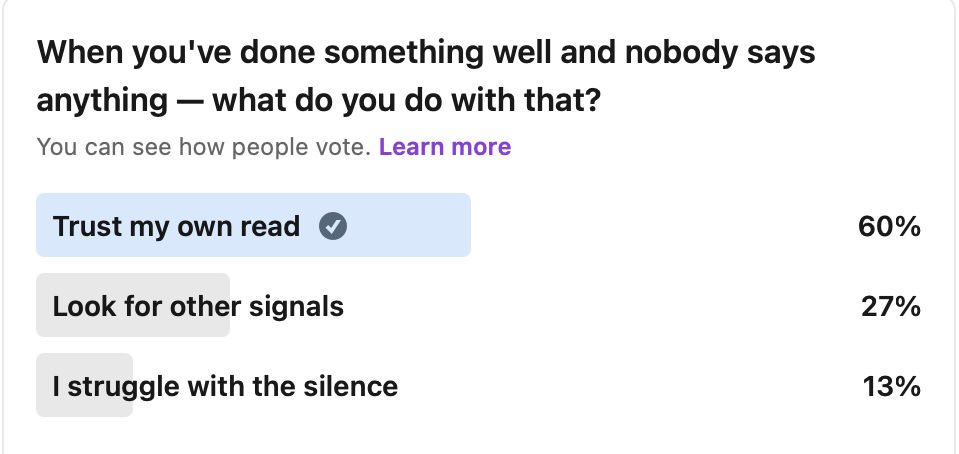
Sixty percent said they trust their own read. That sounds like exactly what a confident leader should say. I fall into this category myself, but here's what gives me pause. Research by organizational psychologist Tasha Eurich found that while 95% of people believe they're self-aware, only 10-15% actually are. More striking: the more senior the leader, the less accurate their self-assessment tends to be — because power gradually reduces the candid feedback that would otherwise correct their blind spots. The higher you go, the less people tell you the truth. So when 60% of us say we trust our own read — the honest follow-up question is: what is that read based on? If the feedback loop is broken, we may be trusting a compass that hasn't been calibrated in a while. And for many of us, if we're being honest, it's simpler than that. We're not actively trusting our read or looking for signals. We're just telling ourselves that no news is good news — and moving on to the next thing. It's not a strategy. It's a coping mechanism.
It works fine. Until it doesn't. The answer isn't to stop trusting yourself. It's to give yourself something more reliable to trust.
Building Your Own Scoreboard
The leaders who navigate this well aren't waiting for external validation to arrive. They've built their own internal metrics. Here's what that looks like in practice:
Define success before you act, not after. Most of us evaluate retrospectively, which makes us vulnerable to whoever speaks loudest in the aftermath. Before a major decision or initiative, write down what good looks like — not outcomes you can't control, but indicators you can actually observe. Are people engaging with the process? Is the problem getting smaller? Is the conversation shifting? Having pre-defined markers means you're measuring against your own criteria, not waiting for someone to hand you a grade. Learn to read lead indicators, not just lag indicators. Enrollment numbers, retention data, budget outcomes — these tell you how you led 12 months ago, and by then the window to adjust has usually closed. What signals can you read right now? Are people bringing you problems, or hiding them? Is the energy in your team meetings different? Are people doing the work without being managed? These are real data points, even if they don't show up in a dashboard.
Recognize invisible wins.
A lot of good leadership work produces no reaction because it worked. The conflict that never escalated because you handled something upstream. The person who didn't quit because a conversation happened at the right moment. The culture that's slowly shifting. These don't generate feedback — they generate the absence of problems. Learning to count that as a win is a discipline worth developing.
Build a small, honest inner circle. Not cheerleaders — people who will tell you the thing you don't want to hear. This is genuinely hard in higher education, where hierarchy makes candid feedback rare. You have to build the relationships that make honesty possible, and demonstrate consistently that you won't punish people for it. When the org chart makes internal honesty complicated — and it often does — peer coaching communities and outside mentors can serve this role just as well. It takes time. But it's worth it.
The Bottom Line
The job was never going to come with a scoreboard. That's simply the nature of leadership at this level. The leaders who sustain themselves over time aren't the ones who've found better sources of external validation. They're the ones who've stopped outsourcing their sense of progress to other people's reactions. That curricular overhaul I mentioned? Somewhere in the months that followed, it started working. Prospective students started noticing. It became a genuine selling point for the program. Students benefited from the new courses and sequences and faculty started championing the changes. Nobody sent a memo about it. Nobody needed to.
Good leadership has always been its own evidence. You just have to know what you're looking for.
Try This Before Friday
Before you close your laptop on Friday, identify one thing you did well this week that nobody noticed. Then answer one question: how do I know it went well? Write down one concrete indicator — not a feeling, a signal. That's the beginning of your internal scoreboard, and it's yours to build from here.
Thanks for reading. See you next Saturday.
When you're ready, here are 2 ways I can help you:
💡 1:1 Coaching
If you're navigating politics, managing difficult personalities, or trying to protect time for the work that actually matters — that's exactly what my 1-on-1 coaching is built for. We work on your specific challenges, not generic leadership advice. A few spots open each quarter. Learn more.
🗣️ Workshops & Speaking
The best workshops don't just inform — they change how people work. I bring interactive sessions — on campus or virtual — focused on the skills academic teams need most: faster decisions, productive conflict, and systems that create time instead of consuming it. Learn more.